
In 1976, an Italian economic historian named Carlo M. Cipolla wrote a short book that should be handed to every marketer on their first day.
It's called The Basic Laws of Human Stupidity. It runs to fewer than sixty pages. It was self-published in a private, numbered edition. Nassim Nicholas Taleb, author of Black Swan, wrote the foreword. It's sold over half a million copies worldwide and it contains one of the most useful frameworks I've seen for understanding why good marketing keeps dying inside organisations that should know better.
Cipolla didn't write about marketing. He wrote about people. But the framework he built explains something every marketer has felt and few have been able to name: the person who keeps destroying your best work isn't doing it for a reason. They're doing it for no reason at all. And that makes them far more dangerous than you think.
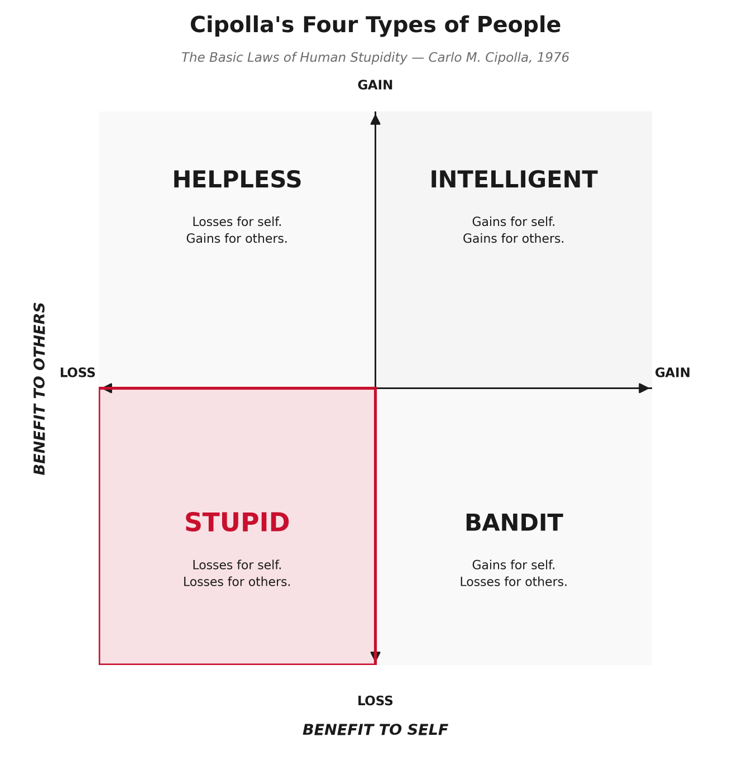
Four types of people. One graph.
Cipolla's idea is simple. Draw two axes. The X-axis is the gain or loss you cause yourself. The Y-axis is the gain or loss you cause others. That gives you four quadrants. Four types.
Intelligent people create gains for themselves and gains for others. Win-win. These are the people who make things work.
Bandits create gains for themselves at someone else's expense. Selfish, but predictable. You can see a bandit coming. You can negotiate with one. You can defend against one.
Helpless people create gains for others at their own expense. Generous but naive. The person who does everyone's job and gets none of the credit.
Stupid people cause losses to others while gaining nothing themselves. They hurt you and get nothing out of it. They might even hurt themselves in the process.
That last quadrant is the one that matters.
Why stupid is worse than selfish
A bandit you can handle. The colleague who takes credit for your campaign, the agency that pads their hours, the vendor who oversells — they're irritating, but they're rational. They want something. You can see the move. You can protect yourself.
A stupid person is something else entirely. They cause damage without logic. They destroy value for no gain. They kill a campaign not because they have a better idea, not because it conflicts with their agenda, but for no reason you can find.
You've been in this meeting. Someone vetoes a strong concept — not because it's wrong, but because "it just doesn't feel right." Three weeks of work, shelved. The replacement? Something nobody loves but everyone can tolerate. A campaign that reaches nobody because it was built to offend nobody.
A net loss for the business. A net loss for the team. And a net loss for the person who killed it.
That's not politics. It's not a power play. It's Cipolla's Third Law:
A stupid person is a person who causes losses to another person or to a group of persons while himself deriving no gain and even possibly incurring losses.
No hidden motive. No secret strategy. Just destruction without purpose.
The five laws for marketers
Law #1: You always underestimate the number of stupid people around you.
You think your team is sharp. You hired well. But Cipolla tested this across every group he could find — workers, students, professors, even Nobel laureates — and found the same proportion of stupid people in each one. Education doesn't change it. Seniority doesn't change it. Your carefully curated team is not exempt.
Law #2: Stupidity is independent of every other quality a person has.
Smart people can be stupid. Experienced people can be stupid. The CMO who rewrites the headline of every ad because they once took a copywriting course isn't being thorough. They're causing losses to the team — wasted time, demoralised creatives, delayed launches — while gaining nothing. The ads don't perform better. They usually perform worse.
Law #3: Stupid people cause losses to others while gaining nothing themselves.
This is the golden law. It's also the hardest to accept, because reasonable people keep looking for the hidden motive. There must be a reason they demanded that approval loop. There must be a reason they made the agency start over in week seven. We search for logic because our brains expect it. But sometimes the answer is simpler and much more uncomfortable: there is no reason.
Law #4: You always underestimate how much damage stupid people do.
This is the law that costs you the most money. You tolerate the person who consistently destroys value because they don't seem dangerous. They're not malicious. They're not stealing budget. They're just… there. Quietly grinding everything down.
Meanwhile, your best people are leaving. Not because they got a better offer. Because they got tired of watching good work turned into beige by someone who gains nothing from the turning.
Law #5: A stupid person is more dangerous than a bandit.
A bandit's damage is a transfer — they gain what you lose. The total stays level. A stupid person's damage is pure destruction. Everyone loses. Nobody gains.
When stupid people accumulate in an organisation, Cipolla says, decline becomes a certainty. "And the country goes to Hell."
Replace "country" with "marketing department" and see if it fits.
This is a people problem, not a strategy problem
Most marketing leaders think about strategy in terms of channels, budgets, messaging, and tech. Almost nobody thinks about the composition of the people around the work.
But Cipolla's analysis is clear. A team thrives when its intelligent fraction is large enough to keep the stupid fraction in check. It declines when the balance shifts — not because there are suddenly more stupid people, but because the smart ones leave, or get outvoted, or stop fighting.
Every time you add someone to an approval chain who destroys value without creating it, you shift that balance. Every time you tolerate a process that protects nobody and slows down everybody, you give the stupid fraction more room to operate.
And every time you think they're not that bad, you are proving Cipolla's Fourth Law.
Choose who you let near the work
Cipolla died in 2000. His slim, funny, unsettling book keeps selling because it describes something everyone recognises but nobody names.
Your team has a stupid fraction. It always will. The question isn't whether stupid people exist in your organisation — Cipolla guarantees they do, and in greater numbers than you think.
The question is whether you've built something that keeps them away from the work that matters.
Surround yourself with people whose actions create value — for the business and for the people the business serves. Protect them. Give them room. Remove the friction that lets the bottom-left quadrant grind good work into nothing.
And if you find yourself unable to explain why a decision was made — if everyone involved came out worse, including the person who made it — stop looking for the logic.
There isn't any. There's only the Third Law.
And the Third Law doesn't care how senior they are.
Before you start mapping your colleagues onto that graph — I've read the book twice and I'm still catching myself in the bottom-left quadrant more often than I'd care to admit. The Laws don't spare the person holding the pen either.